























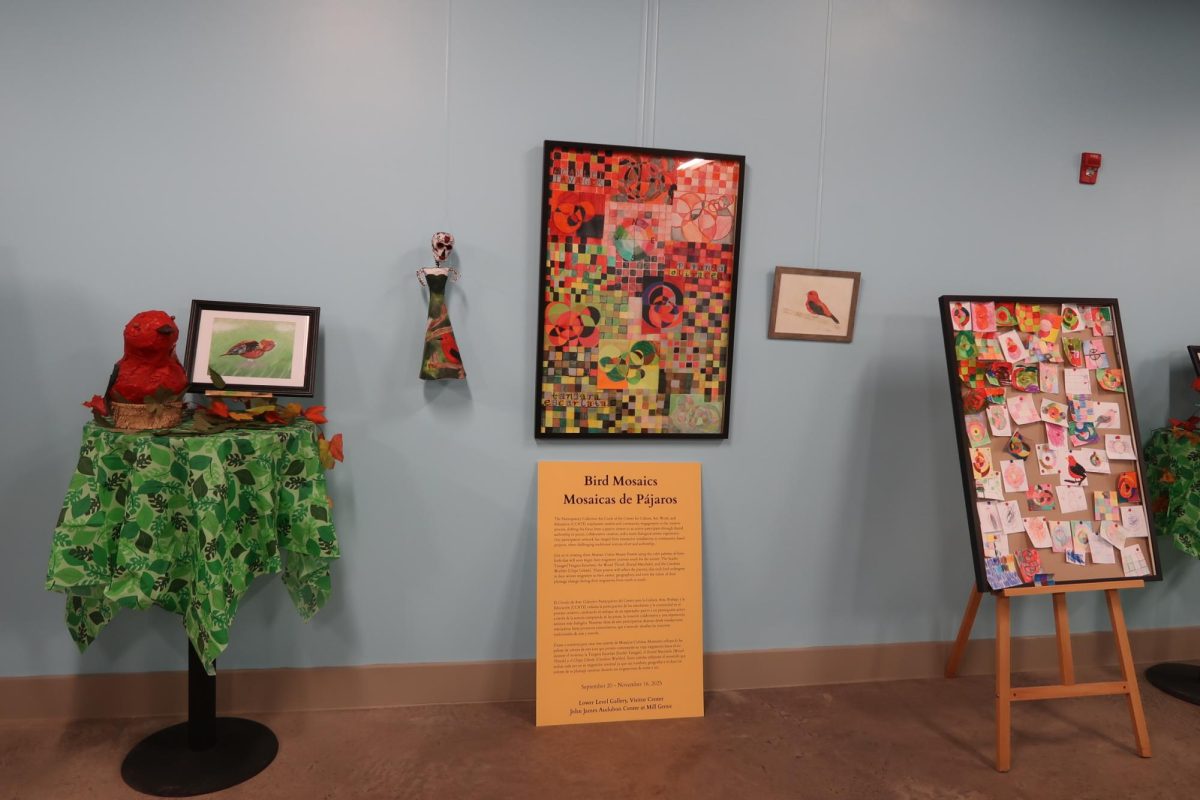
Children sit at tables, meticulously folding origami cranes as their parents wander the gallery, admiring the mix of sculptures, paintings and mosaics. The John James Audubon Center recently hosted a limited time exhibit from Sept. 21 to Nov. 16 featuring three birds: the wood thrush, scarlet tanager and cerulean warbler.
The Centro de Cultura, Arte, Trabajo, y Educación (CCATE) collaborated with the John James Audubon Center to create this exhibit. CCATE, a nonprofit based in Norristown, works to uplift the Latinx community by fostering creativity, educational opportunities and career growth. John James Audubon Center employee Isabel Rivera values the symbolic meaning of the exhibit’s theme.
“I really like the knit project that says ‘migration is beautiful.’ It shows that migration is natural in nature and affects people as well,” Rivera said.
The exhibit focused on the three birds because these species depend on Pennsylvania forests for nesting and breeding before journeying to South and Central America for the winter. Caitlin Brady, manager of Outreach and After School Education at CCATE, explains an artwork that represents the migration of the birds.
“In the north, (the birds) have their English names and scientific names, and as they migrate south, their name changes into the Spanish name for them,” Brady said. “We represent that in the poster from north to south. That’s my favorite piece because it was a piece that was designed by our students, and I think it turned out really cool: this reflection on color, migration and language changing.”
The array of artwork featured a variety of mediums including sculptures, poetry, original music, paintings, linen fabric panels and papier mâché sculptures. A unique component of the showcase was the collaborative aspect, where visitors could color individual squares of paper using the color palettes of the featured birds, which were then joined together into a collective artwork. Valerie Peckham, the Public Programs Manager at the John James Audubon Center, helped to organize the collaborative project opportunity.
“The participatory element helps people have ownership and investment in what the subject of the art is,” Peckham said. “We’re in the process of trying to figure out how we’re going to utilize the collective art once it’s finished. I’m sure that we’ll hang them, we’ll feature them and we’ll start developing some programming. We might do some retail items and different things to use (the collective art) to reflect on and engage people around those connections with the community. That aspect of the exhibition is important to keep a lot of the sentiments of the exhibit going even after it ends.”
Isabelle Emmanuel can be reached at [email protected].