






















































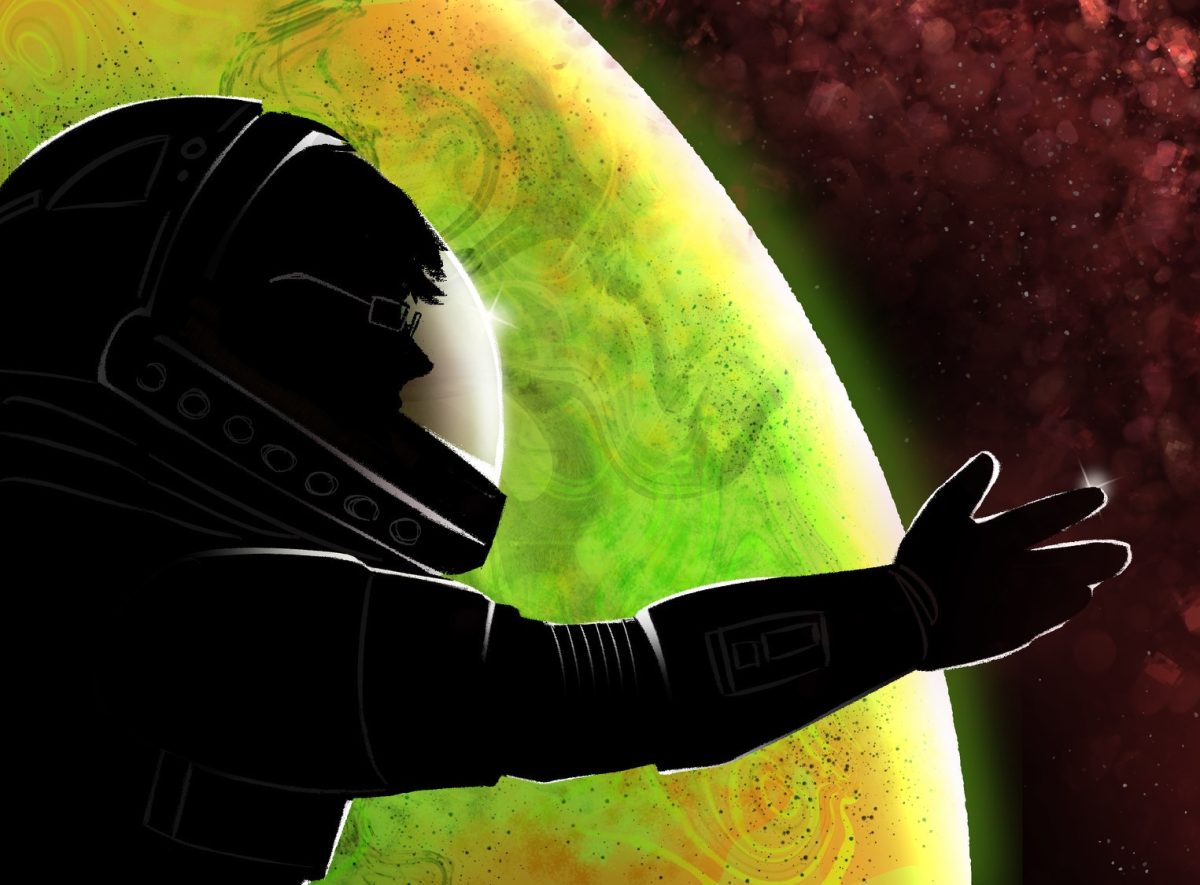
Adapted from a bestselling novel of the same name by Andy Weir, “Project Hail Mary” wittily tells a tale of bravery and scientific achievement. The film follows middle school science teacher Dr. Ryland Grace, played by Ryan Gosling, as he wakes up from a coma on a spaceship and slowly regains his memory. He discovers he is the sole surviving astronaut on a “Hail Mary” mission to help save the sun from decaying at the hands of astrophage, a mysterious organism.
However, Grace won’t have to face the future alone, as he meets Rocky, a fittingly- named and lovable alien that is on the same mission for its planet, Erid. During filming, a team of six puppeteers brought Rocky to life, so that Gosling could have a scene partner while filming. Their efforts are apparent in Gosling’s authentic, little-brother-like chemistry with Rocky.
The film features breathtaking and dramatic silent spacewalk scenes. The visuals are stunning throughout, as expected from its roughly $200 million production budget. Released on March 20, the movie marks Amazon MGM Studios’ first major box office success.
Gosling’s performance is exactly what was expected of the acclaimed actor. His talent shines especially in moments of self-doubt and vulnerability, particularly when he admits to Rocky that he wants to go home. Rocky, in turn, grounds Dr. Grace, pulling him out of his isolation and making the film far more engaging.
While not particularly subtle or nuanced, the film’s message about how bravery is not about being born brave, but rather rising to the occasion, is a classic moral that contributes to the feel-good mood. Seeing the character of project director Eva Stratt’s dedication and international scientists working together paints an optimistic picture of the future.
Compared to the novel, the movie is less rich in scientific depth and humor, instead relying more on Gosling’s personality and Rocky’s silliness. Perhaps more internal dialogue from Gosling could give viewers a glimpse into the mind of a scientist.
Understandably so, critics point out the lack of true tension and conflict in the plot, as there is a constant sense that Grace will prevail against the odds. But “Project Hail Mary” seems uninterested in making audiences feel a lonely astronaut’s despair. Instead, the persistent optimism and sometimes cheesy humor (“Fist my bump?”) create a timeless, uplifting film in a genre normally defined by dystopia and disaster.
Miya Cao can be reached at [email protected].