
















































I used to watch climbers in pure awe, amazed that they could scale a wall using their hands and feet, but nothing could have prepared me for how much my respect for the sport would grow the moment I tried it myself.
Sophomore and rock climber Mallory Wollick, who has been climbing for four years, taught me the basics of gear and climbing.
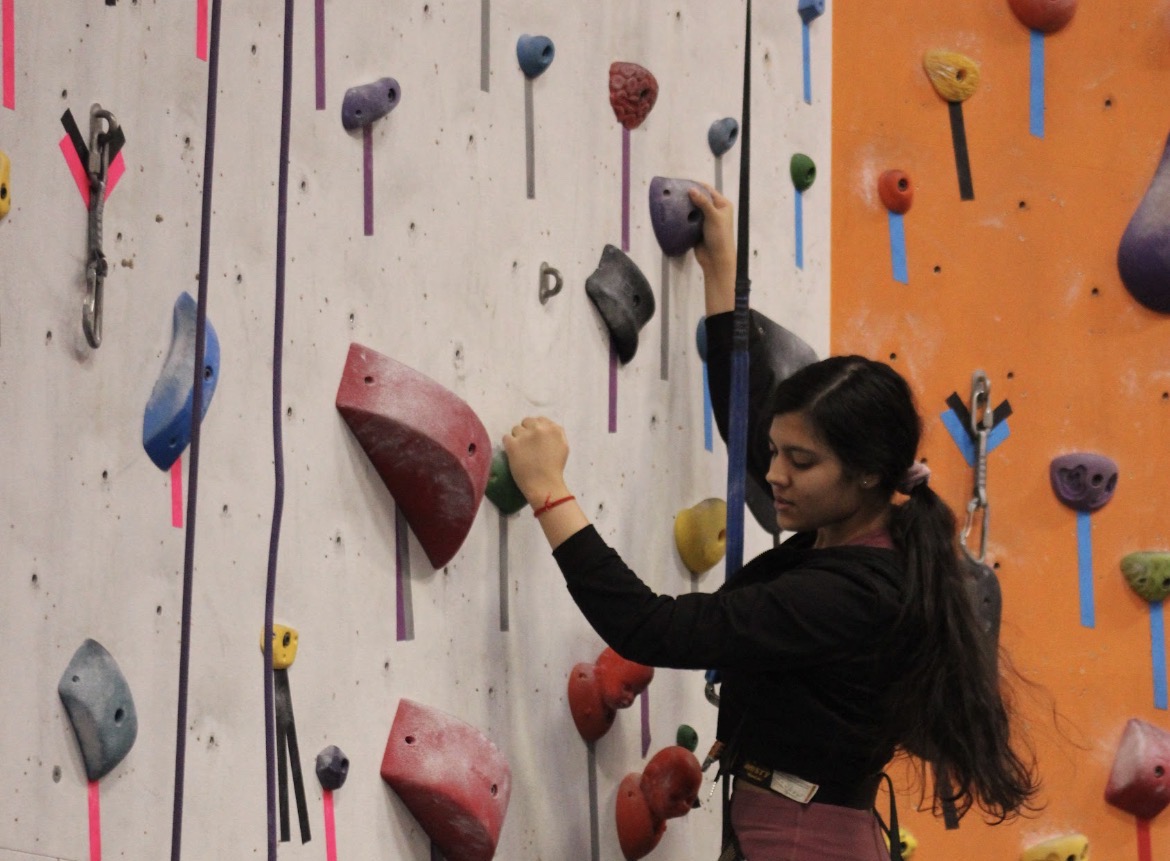
Wollick helped me put on the harness and explained that the climbing shoes are designed to allow you to curl your toes slightly to grip the rocks with your feet.
We started with top rope climbing, where one person climbs while a partner on the ground controls the rope. This type of climbing is centered on trust, as you have to believe that the person holding your rope will catch you if you fall. As I made my way up the wall, I could feel every muscle in my body working while my mind raced trying to figure out where to place my hands and feet. At one point, I slipped and lost the wall completely. I dangled in the air and struggled to get back on, but Wollick talked me through it and I found my footing again. The higher I climbed, the heavier my body felt, but seeing the top so close was all the motivation I needed to keep going. By the time I came back down, I was drenched in sweat and completely out of breath. I needed to rest before moving on.
Next we tried auto belay, which is similar to top rope but instead of a partner, a machine at the top lowers you down slowly when you let go. It is great for solo practice but if you slip, you would have to start over. The tricky part for me came at the very top. The leash felt loose and I was too scared to let go of the wall. It took a moment to remind myself to just trust the machine. When I finally let go, it caught me, just like it was supposed to.
Finally, we tried bouldering, and it was a whole different experience. There is no harness, no partner and no machine to catch you. The walls are shorter, but the routes are more technical and require more problem solving. Since nothing will catch you if you fall, it is important to know how to fall safely by keeping your arms close to your chest and making sure no one is below you.
Bouldering was the most intimidating type of climbing for me. With nothing but a mat below, every move I made felt nerve-racking. It also made me aware of the different types of rocks on the wall. The easiest ones and my favorite were the jugs, which were easy to grab and hold onto. The hardest ones were the crimps, which were the tiny rocks that required finger strength to keep me from slipping.
For all the climbs, I stuck to the easiest paths to lower my chance of falling. When I pushed myself to try a harder path on the auto belay, I lost my strength before I could make it to the top. Rock climbing requires a lot of practice and method. The whole experience felt like solving a giant puzzle that just happened to be vertical.
Riddima Pandey can be reached at [email protected].