







































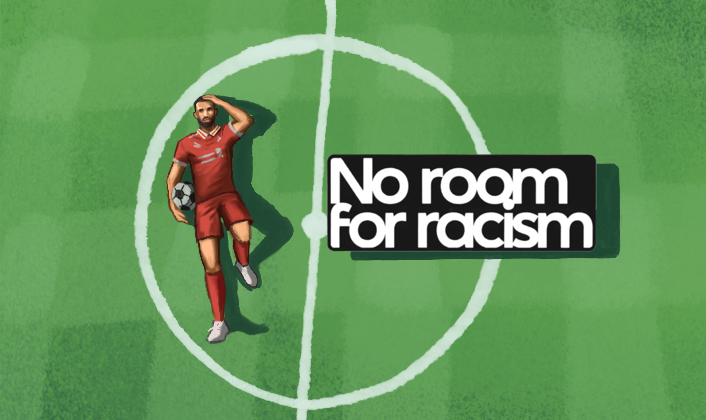
Flags of every color dance through the wind unwaveringly, people unite in pride for their country. As the World Cup offers a unique atmosphere for fans to come together and players to prove themselves, one thing stands in the way: FIFA’s failure to respond to racism.
A 2024-25 report from Kick It Out, an organization that works with soccer’s governing bodies to raise awareness against discrimination and serves as a platform to report abuse, cited 245 instances of racism in professional soccer. That’s a 10% increase from last season’s 223 reported instances. Disturbingly, the organization also reported a six-fold increase in racist mass chanting. Although such statistics seem absurd for many, they represent the harsh reality players of color are forced to endure every time they step foot onto the turf.
Several players immediately come to mind when considering racial discrimination across soccer. Vinícius Júnior of Real Madrid, for one, recently engaged in an altercation with Benfica’s Gianluca Prestianni, who covered his mouth with his jersey while speaking. Vinícius Júnior accused Prestianni of calling him a racist slur. Mouth-covering hinders the ability of cameras to capture speech; now, this has become a widespread practice as players attempt to conceal racist remarks. Liverpool’s Mohamed Salah is no stranger to this abusive behavior either, with several soccer fans receiving three-year bans from all U.K. stadiums for racist, islamophobic outcries against him.
These aren’t simply isolated incidents, but common patterns of racial abuse in soccer. So, where does FIFA stand?
On May 17, 2024, current FIFA president Gianni Infantino solidified the governing body’s strict anti-racist stance, presenting a universal “Global Stand Against Racism” approach at the 74th annual FIFA Congress. Despite Infantino’s moving promises, one thing remains clear: FIFA prioritizes profit over the safety of its players. According to a report by The Athletic, the sports journalism branch of The New York Times, the governing body did not permit displays or advertisements with anti-racist messaging to be exhibited in domestic venues for the 2025 FIFA Club World Cup. In addition, the U.S., where FIFA plans to hold three-quarters of World Cup, is currently withstanding a “human rights emergency,” as described by major human rights movement Amnesty International. Why would FIFA select the U.S. to co-host the largest global sporting event amid its tense political climate, you may ask? The North American bid assured FIFA $11 billion in profit; as usual, the answer boils down to how much money FIFA officials can fit in their pockets.
Some argue that FIFA has taken the proper steps to combat discrimination, especially after Infantino’s aforementioned speech and the implementation of the “Global Stand Against Racism.” Key components of this initiative include the crossed-arm gesture, which enables players to signal accounts of racism to referees and the three-step protocol that requires referees to stop, suspend or abandon a game if abusive behavior continues. Nevertheless, these measures aren’t sufficient and can’t protect players; if FIFA is truly committed to its anti-racist stance and seeks to make a change in the sport, it doesn’t get to choose only certain instances in which to intervene.
As a co-host of the World Cup, the U.S. has a major responsibility to cease acts of racially profiling and unlawfully detaining individuals. FIFA too, needs to step up its efforts to enforce its anti-racist protocol and allow anti-discriminatory slogans in these defining moments. We have an obligation to protect what Pelé, a popular Brazilian professional soccer player, once referred to as “the beautiful game.”
Sophia Seyedian can be reached at [email protected].