





















































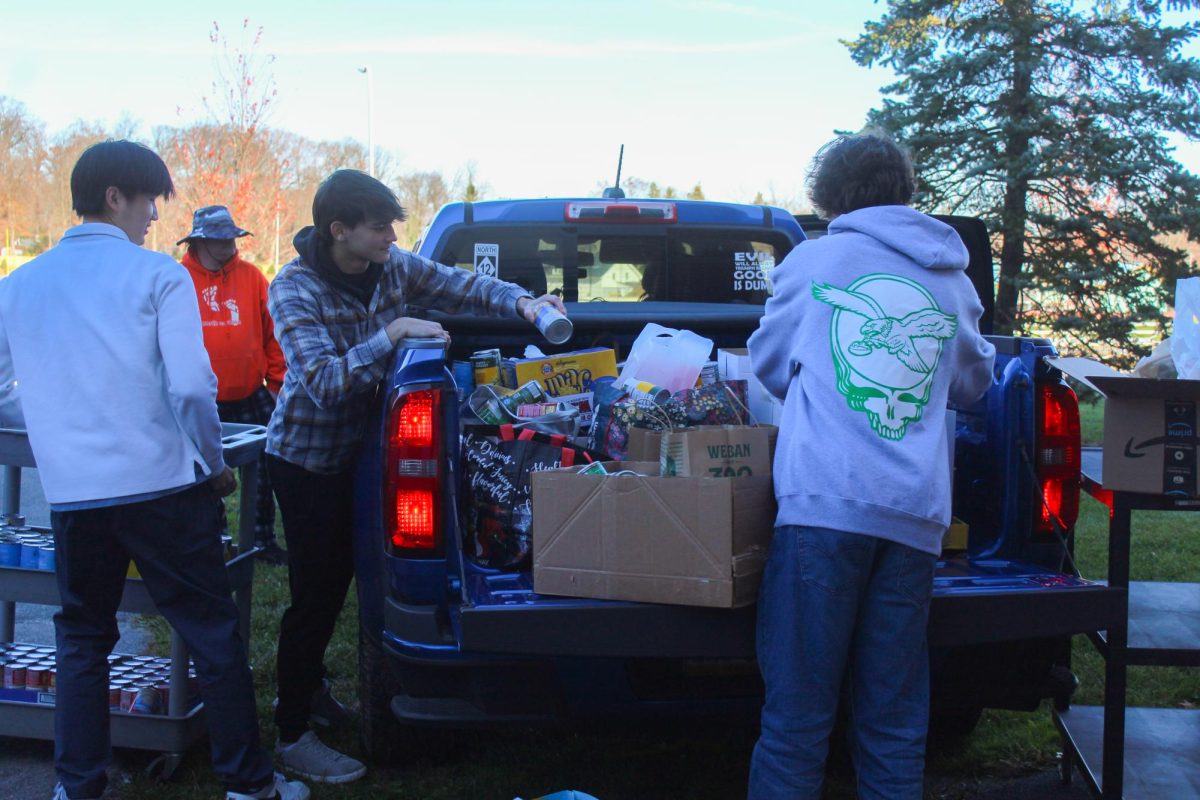
Student Council members gather outside with carts, boxes and bags full of donated food on Nov. 24. Joined by other students, they load cars with more than 4,000 cans of donations from their annual food drive. This year’s collection, along with various other community efforts, aimed to support local food banks in response to a temporary delay in operations of the nation’s largest anti-hunger program, Supplemental Nutrition Assistance Program (SNAP). In November, the federal government shutdown caused SNAP to experience the first national-level disruption to the issuance of food benefits in the program’s 60-year history.
“We’re able to provide this opportunity for those who want to help out in the community to even do something small,” senior and Student Council president Jeffrey Wang said. “The goal is just to help people, and it just so happens that this year there’s probably more people that need aid, unfortunately.”
SNAP provides electronic benefits transfer cards for low-income families to purchase eligible food items at grocery stores, farmers markets and online retailers. Currently, the federal government funds monthly benefits while states administer the program to recipients. According to the official website of the Commonwealth of Pennsylvania, nearly one in eight state residents depend on SNAP.
Due to the recent federal government shutdown, which started on Oct. 1, states received delayed funding to implement SNAP payments during the month of November. The disruption continued until Nov. 12, when President Donald Trump signed a funding bill reopening the federal government. State Rep. Melissa Shusterman, who serves Chester County, advocated for the national administration to fund SNAP and collected food donations during the shutdown.
“According to DHS (Pennsylvania Department of Human Services), nearly two million Pennsylvanians (rely) on SNAP benefits. With the delay of these benefits along with delayed payments of state funding and grants because of the state budget impasse, our county governments and food banks were experiencing additional financial pressures,” Shusterman wrote in an email. “At the state level, my colleagues and I signed a letter urging the federal government to utilize available emergency funds for SNAP. PA does not have the bandwidth to cover these federal benefits.”
The United States Department of Agriculture (USDA) notified states on Oct. 10 that it would not use contingency funds to cover November SNAP benefits. On Oct. 31, two federal judges from Massachusetts and Rhode Island ruled that the USDA must use the emergency funds. However, the funds only covered around half of the necessary monthly benefits.
Administrative delays and conflicting court rulings led to partial payments and differing levels of SNAP distribution across states until the reopening of the federal government. On Nov. 12, the USDA officially began directing states to distribute full SNAP payments. The Pennsylvania DHS finished restoring all of SNAP’s November benefits on Nov. 14.
Kevin Ressler, CEO of the Coatesville-based public health organization Alliance for Health Equity, emphasized the importance of SNAP and food security.
“Food justice is a critical component of ensuring that we have a society that is productive, effective and healthy,” Ressler said. “What does it mean to be a part of this country and this culture? We’ve had a history of providing support for folks.”
State lawmakers respond to SNAP delays, cuts
In response to the USDA’s initial announcement of SNAP delays, Pennsylvania Gov. Josh Shapiro joined a coalition of 24 other states on Oct. 28 to file a lawsuit against the agency requiring the release of the emergency funding toward SNAP benefits. Shapiro also directed $5 million in state funding toward Feeding Pennsylvania, a nonprofit that partners with food banks across the state, and the Pennsylvania government launched a private fundraising campaign, raising $2 million for the “SNAP Emergency Relief Fund.”
At a local level, Shusterman has aimed to address food insecurity in light of recent disruptions.
“As a State Representative, my office and I have worked closely with the Chester County food bank to collect food donations at my district office,” Shusterman wrote. “I have also advocated alongside my colleagues calling for the federal government to fully fund SNAP benefits and pushed for the state budget negotiations to end so that our food banks can receive state funding.”
The Pennsylvania budget delay ended with the reopening of the federal government on Nov. 12. The 2025-26 state budget includes an $11 million increase in funding to combat food insecurity, with a total of more than $40 million. The changes include $3 million for the State Food Purchase Program, $1 million for the Pennsylvania Agricultural Surplus System, $2 million for a new State Food Bucks program to supplement SNAP and $5 million in new funding to Pennsylvania food banks.
Recent legislative action has also altered aspects of SNAP’s funding and eligibility requirements, which depend on residents’ assets, standards of income, household size, immigration status and proof of employment. The One Big Beautiful Bill (OBBB) Act, a budget reconciliation bill passed on July 4, extends the work requirement for receiving regular monthly benefits to individuals aged 55-64 and parents of children 14 years and older. People who were previously exempt, including veterans, those experiencing homelessness and former foster youth, also have to comply with the requirements. Some refugees who are not U.S. citizens are no longer eligible to receive SNAP benefits. The USDA gave states a 120-day grace period to implement the altered requirements, ending on Nov. 1.
Additionally, starting Fiscal Year 2027, the OBBB shifts a larger portion of SNAP administrative and benefit costs from the federal government to the states. Congressional Budget Office’s Estimated Budgetary Effects of Public Law 119-21 expects federal spending on SNAP to decrease by $186 billion over the next decade. Nicholas Imbesi, Director of Community Relations at the Chester County Food Bank, highlighted the impact of the bill’s effects on local food pantries.
“It (OBBB) put a lot more restrictions in place for food stamps. It makes people renew more frequently on food stamps. It puts additional working requirements in place. It pretty much makes it harder for people to get SNAP, get food stamps,” Imbesi said. “It’s going to have a big impact. There’ll be a lot of individuals who are no longer able to receive food stamps, and ultimately they’re going to be turning to us and our community partners in order to get their food needs met.”
Local efforts, organizations seek to support food banks
In response to the SNAP changes, various community members and organizations have worked to promote food security. On Oct. 31, the TESD Mental Health Specialists launched an online “Community Assistance Request Form,” which aims to direct families in need to support. First introduced through an email blast to parents, the mental health specialists connect those who complete the form with a suitable community organization helping with food insecurity and other economic hardships.
Jana Golboro serves as a mental health specialist for Hillside, New Eagle and Valley Forge Elementary.
“The online form was developed this school year to help families streamline the process of requesting support,” Golboro wrote in an email. “In the past, families contacted a variety of school individuals for need: a teacher, a school counselor, a mental health specialist. Our hope is that with one centralized location, families can access this tool at any time, not solely during school hours.”
Imbesi said that more county residents turned to local food resources during SNAP benefit disruptions and that the Chester County Food Bank is on track to distribute more than 8 million pounds of food this fiscal year. According to its 2024 and 2025 annual impact reports, the organization distributed 4.6 million pounds of food in 2024 and 6.1 million pounds of food in 2025.
“We definitely saw an uptick in people facing food insecurity solely because they weren’t receiving their SNAP benefits,” Imbesi said. “We were out on state funding because the state didn’t have a budget for the longest time. Therefore, we were out every quarter.”
To help meet the increasing demand, local organizations Chester County United Way, Chester County Community Foundation, Alliance for Health Equity and United Way of Southern Chester County formed the “Help Feed Chesco” campaign starting on Oct. 31. For every dollar donated to the Chester County Food Bank, the organizations reciprocated the amount using a matching fund. Each group contributed $25,000 for a combined $100,000 available in the fund, and the campaign raised $219,238 throughout November.
Director of Community Impact at Chester County United Way Amanda Blevins emphasizes the importance behind launching the campaign.
“We really just had heard about the increasing need that was coming across the county with what was potentially going on with the SNAP benefits and what’s going away,” Blevins said. “We were hopeful that (the $100,000 matching fund) would be a number that would help individuals be motivated to give and to just really demonstrate that when we work together, we are able to accomplish some pretty big things.”
In addition to the $200,000 donation goal, “Help Feed Chesco” aimed to collect 50,000 pounds of non-perishable food items to be donated to Chester County Food Bank. Blevins feels that such efforts by Chester County residents showcase the importance of food security and overall influence of SNAP benefits on those in need.
“There was food insecurity in our community before. Maybe there was a spotlight shined on it because of the SNAP benefits and the SNAP situation,” Blevins said. “We continue to see individuals, unfortunately, have to reach out for assistance. But we’re just glad that that assistance is really there. Food security can be a complicated issue, but we’re glad to be able to help to mobilize some resources to help support our neighbors.”
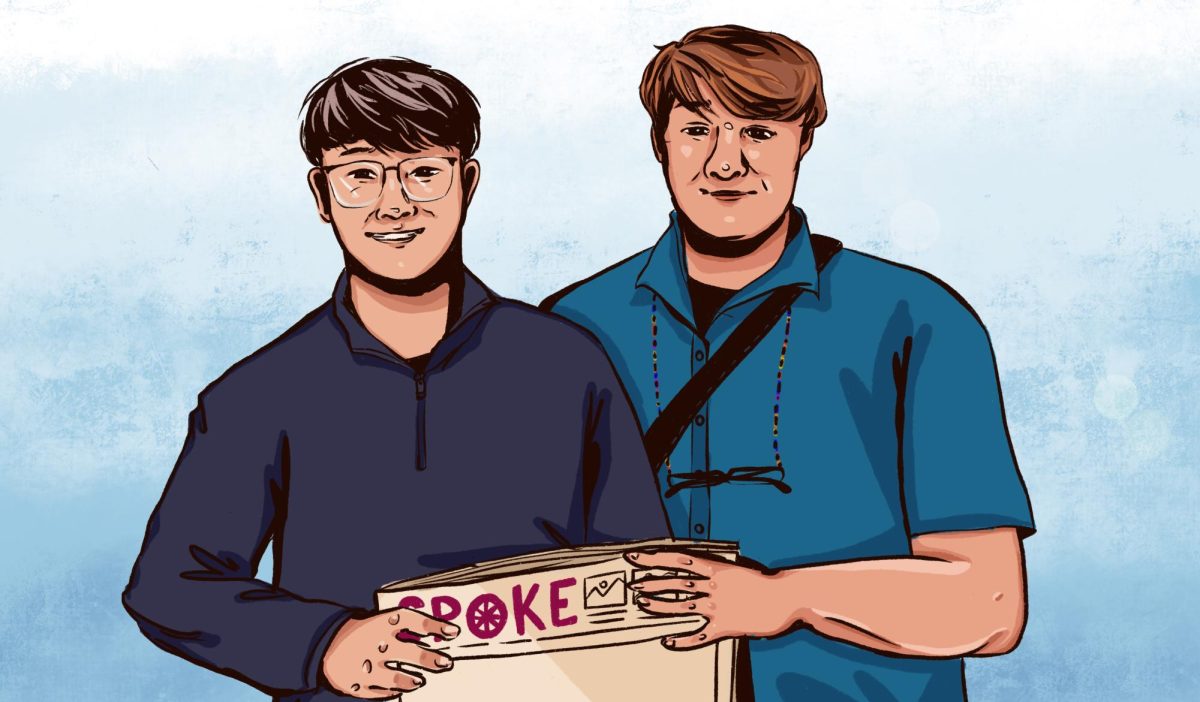
Sophia Cui can be reached at [email protected].
Ashley Du can be reached at [email protected].
Erin Zhang can be reached at [email protected].